The Line of Fate: The Campaign of Alexander III of Macedon
An original project from the “History in Motion” series.
About the project
1
Project history
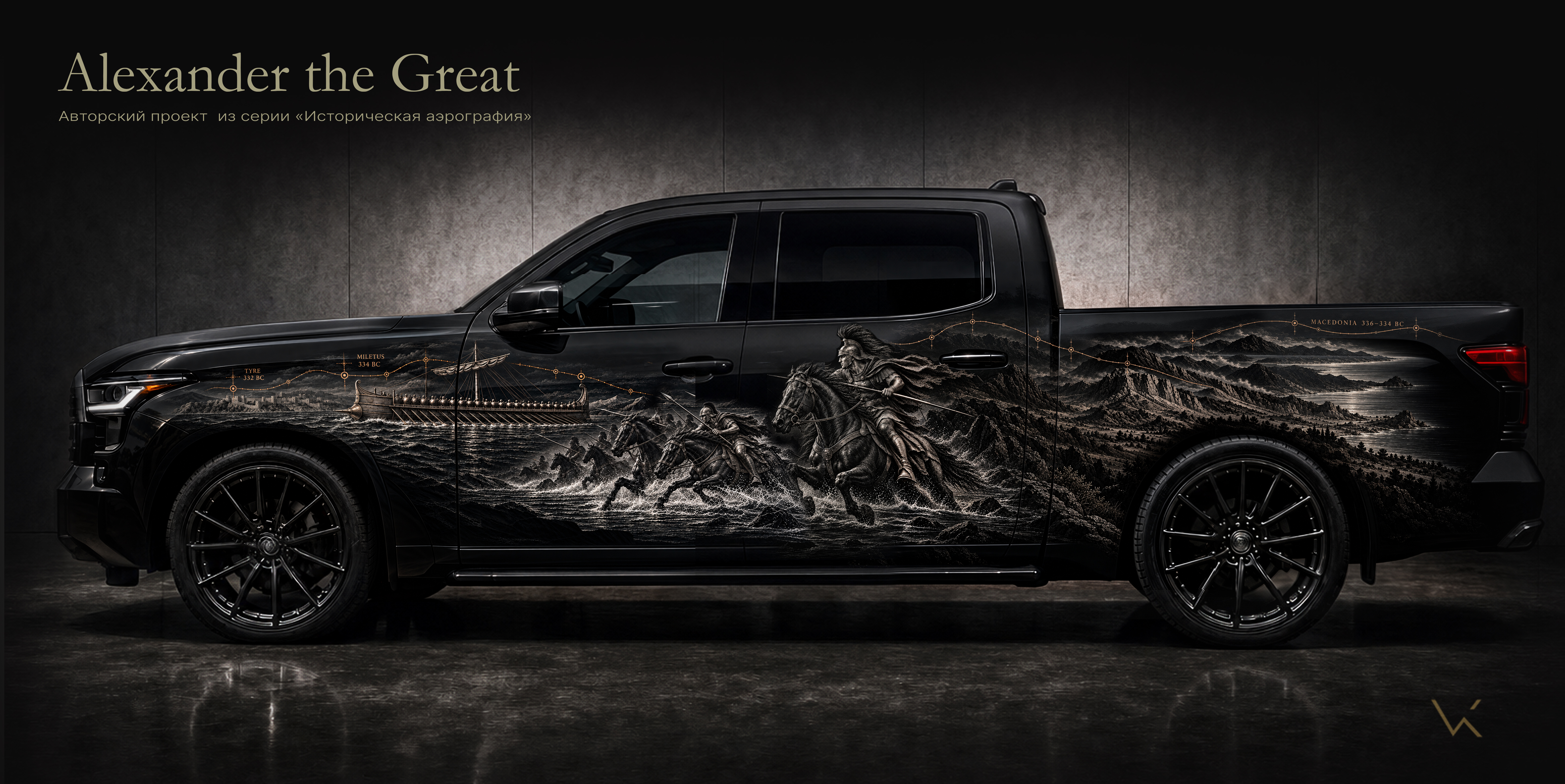
This project is devoted to the journey of Alexander the Great—not as a sequence of separate battles, but as a single line of movement connecting land, sea, cities, an army, and human will.
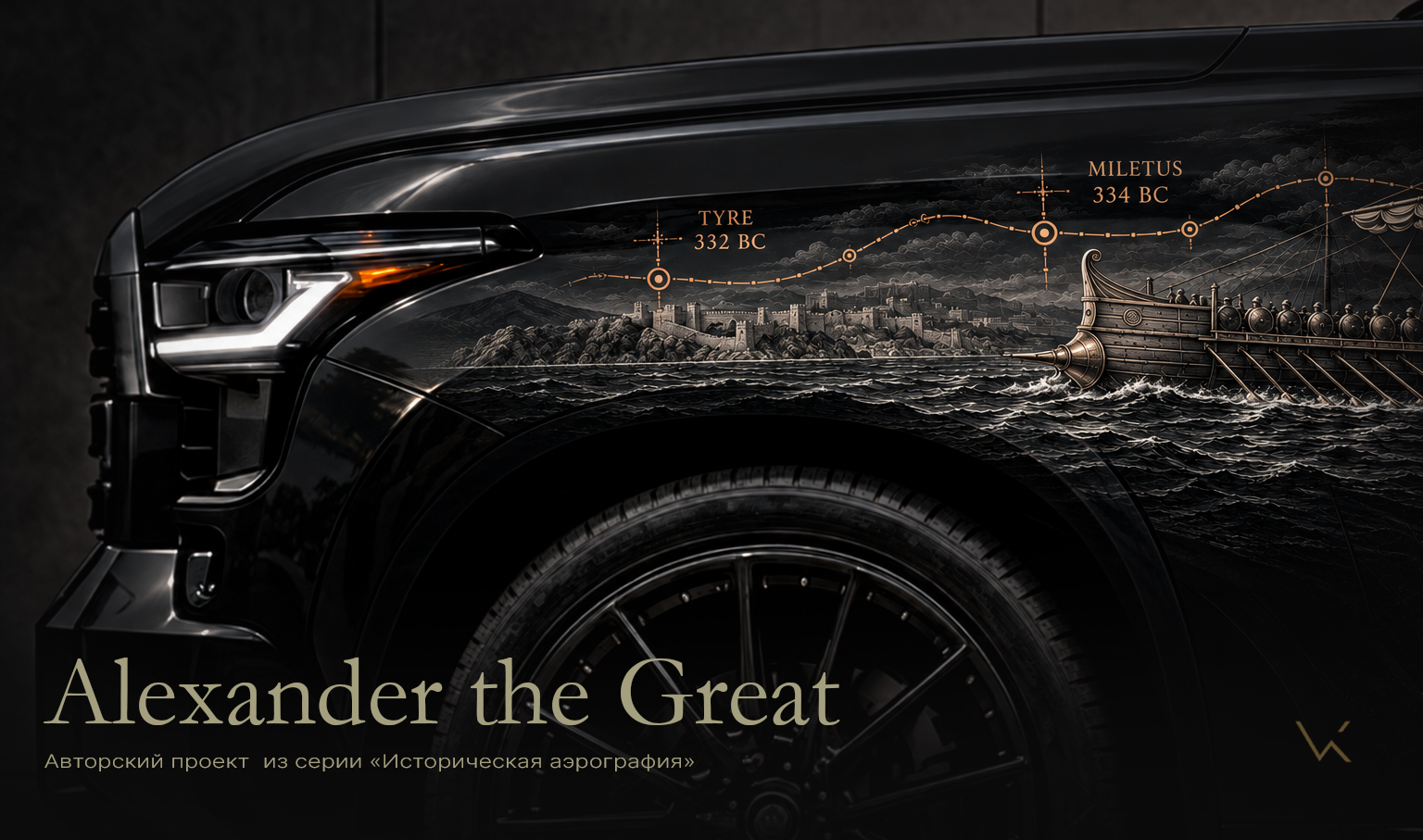
The composition unfolds across the vehicle’s body as a historical route. Macedonia becomes the point of departure; mountain ranges, straits, sea crossings, Miletus, and Tyre form a continuous space of the campaign. A bronze route line runs through the entire artwork, linking its episodes and transforming historical geography into an image of fate, choice, and forward movement.
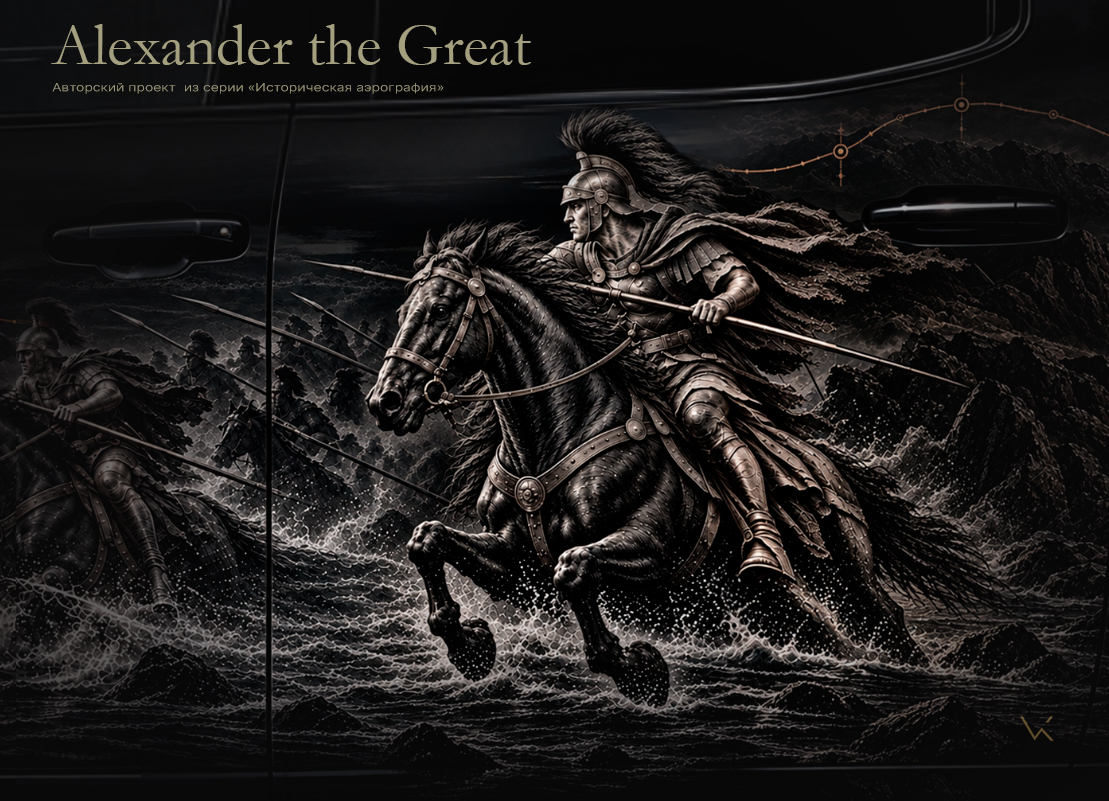
The galley, coastal fortifications, cavalry, and water do not exist here as separate illustrations. They form a unified visual current: the sea transitions into stone and mountainous relief, distant planes dissolve into engraved atmosphere, and the movement of the army continues across the vehicle’s surface. The actual body lines, door handles, wheel arches, and black intervals become part of the compositional rhythm.
The visual language is rooted in engraved пластика translated into airbrush technique. Cool graphite, silver, and pewter tones create depth and a sense of historical distance; restrained bronze marks the route, dates, and key geographical points. The black lacquer is not merely a background—it preserves scale, air, and tension between the episodes.
“The Line of Fate: Alexander the Great’s Campaign” is a work about a journey that leaves its trace not only on the map, but also in cultural memory. History is not reconstructed here literally—it is set in motion.
History in Motion
History rarely comes to us as a complete narrative. More often, it appears as a fragment of a frieze, part of a map, an ornament on a weapon, the name of a city on a half-erased stone. We join these fragments, assuming there is an order between them—although perhaps order is created only at the moment of reading. The series *History in Motion* emerges from this question: can historical memory be placed not inside a museum display case, but upon the surface of an object made for speed?
Here, the automobile neither becomes an illustration of the past nor serves as a neutral carrier of decorative imagery. Its body turns into a moving plane of reading, where light, shadow, and shifting viewpoints alternately reveal and conceal signs. The movement of a wheel continues the line of a campaign, the trajectory of a sea route, the curve of an ornament, the motion of a wing. What in a book would unfold sequentially exists here all at once—like a map that cannot be seen in its entirety from a single point.
*Ragnarok: Black Relief* turns to the Northern myth: to its knots, ravens, serpents, and the dark memory of metal. *Alexander the Great* is constructed differently—as a route in which the history of conquest is read through distances, shores, cities, armies, and lines of advance. In the future, the series may speak through other visual languages—for instance, through the rhythmic, calendrical, and cosmological logic of Maya ornament. Yet each new project will not be a reconstruction of a culture, but an attempt to hear how its signs continue to operate beyond their original time.
Thus, the collection is not about the past as a motionless archive, but about a past that changes its meaning with every new glance. The car moves away, the image breaks apart in reflections, ornament becomes a route, and the route becomes a text. And the viewer understands: history does not remain behind us. It moves alongside us—sometimes faster than we do.
Reservation and project implementation terms are discussed personally.