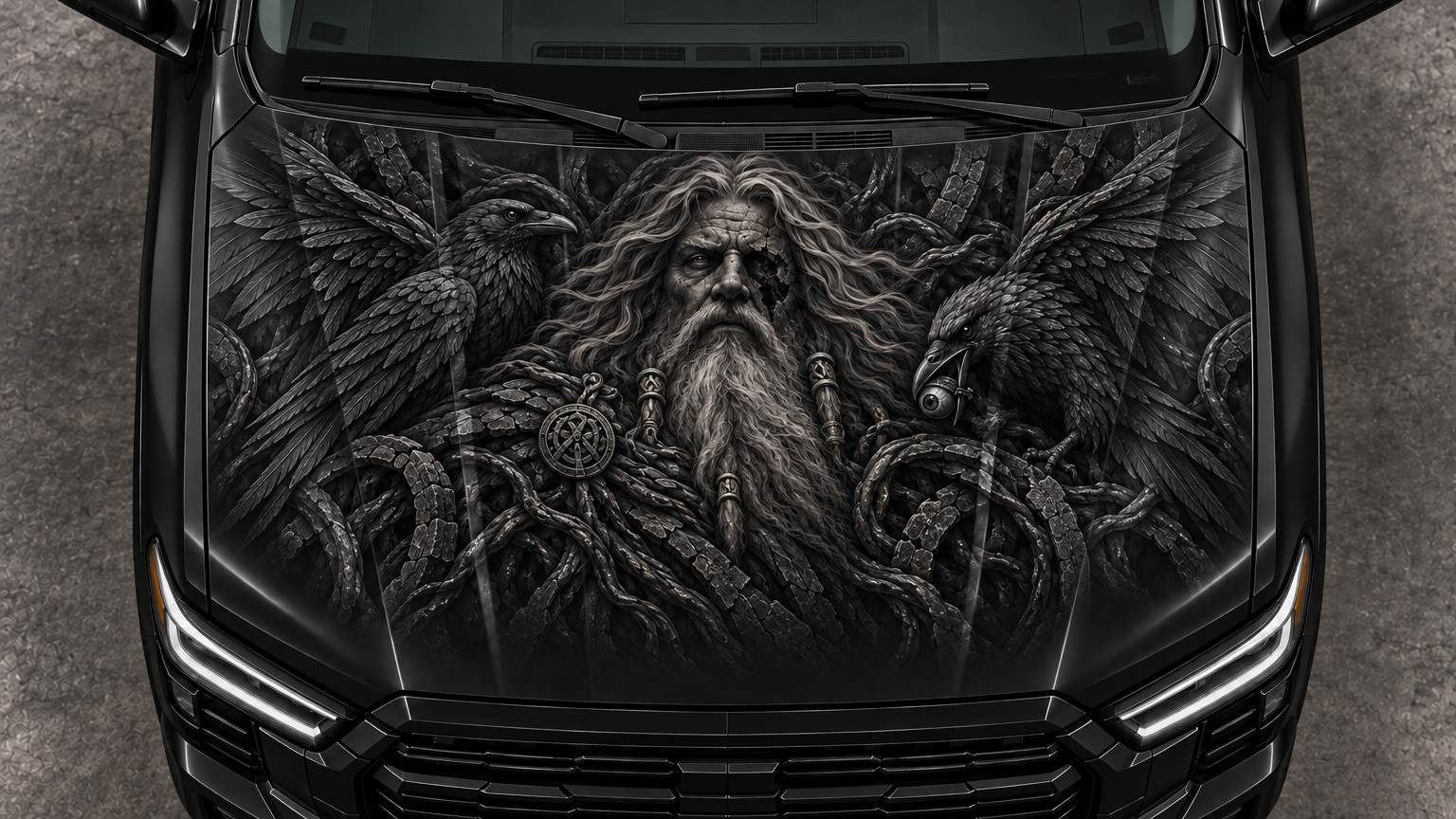
Every car has its own mythology: it is born on an assembly line, receives a name, a number, a route—and gradually gathers the traces of other people’s roads. But sometimes it is given back a memory it never possessed: the memory of a world in which a journey was measured not in kilometres, but by the distance between an oath and its fulfilment.
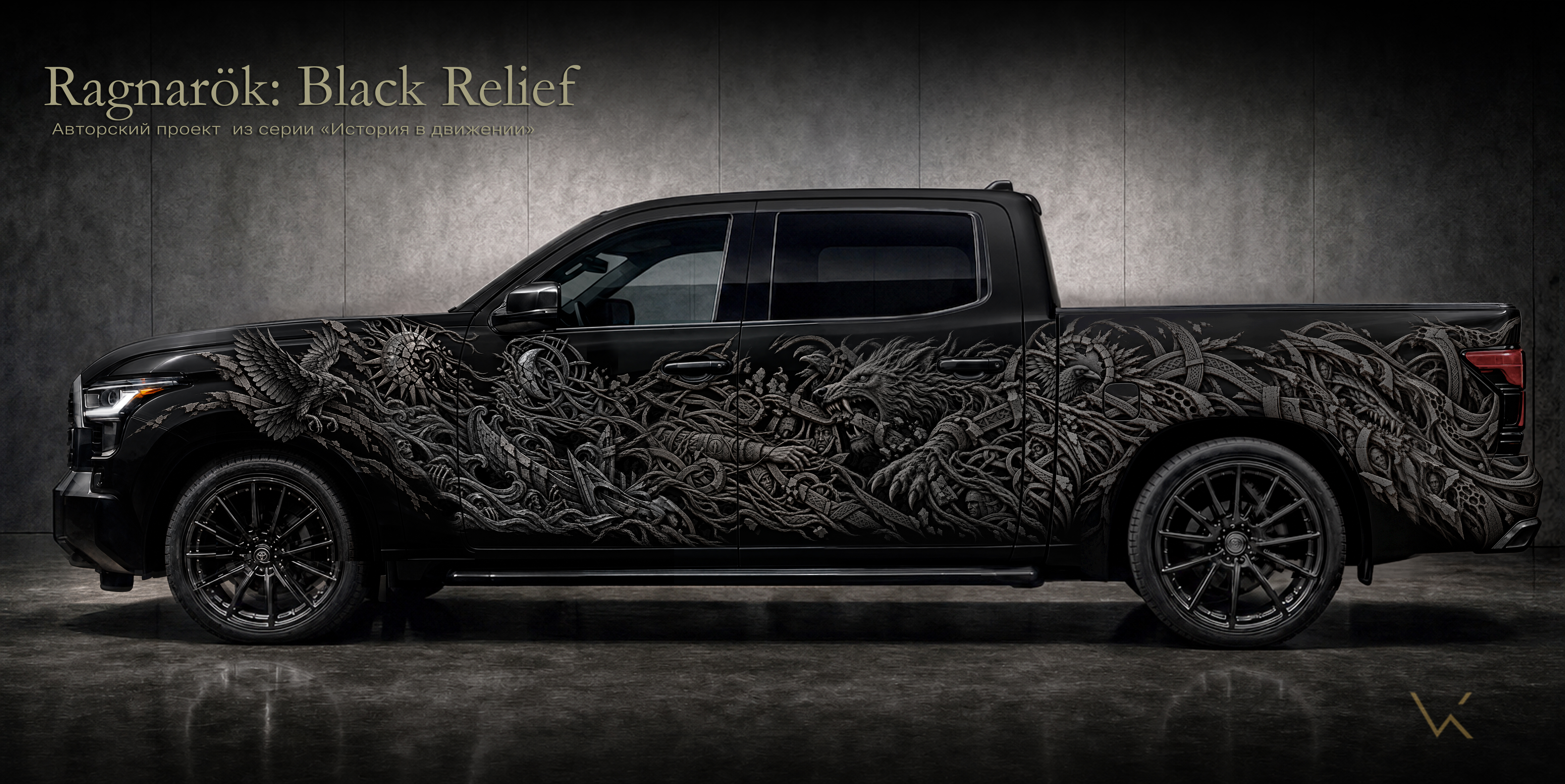
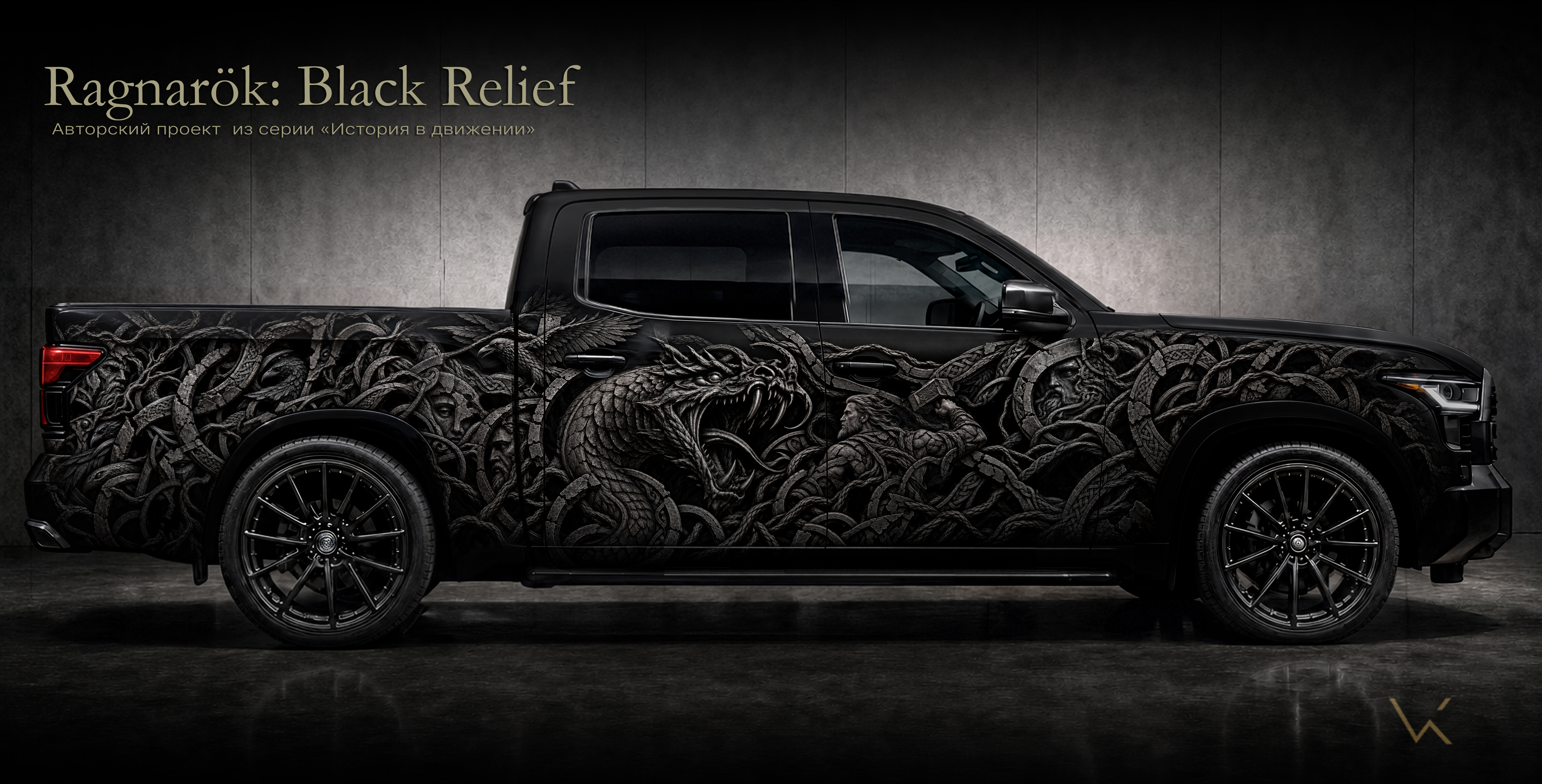
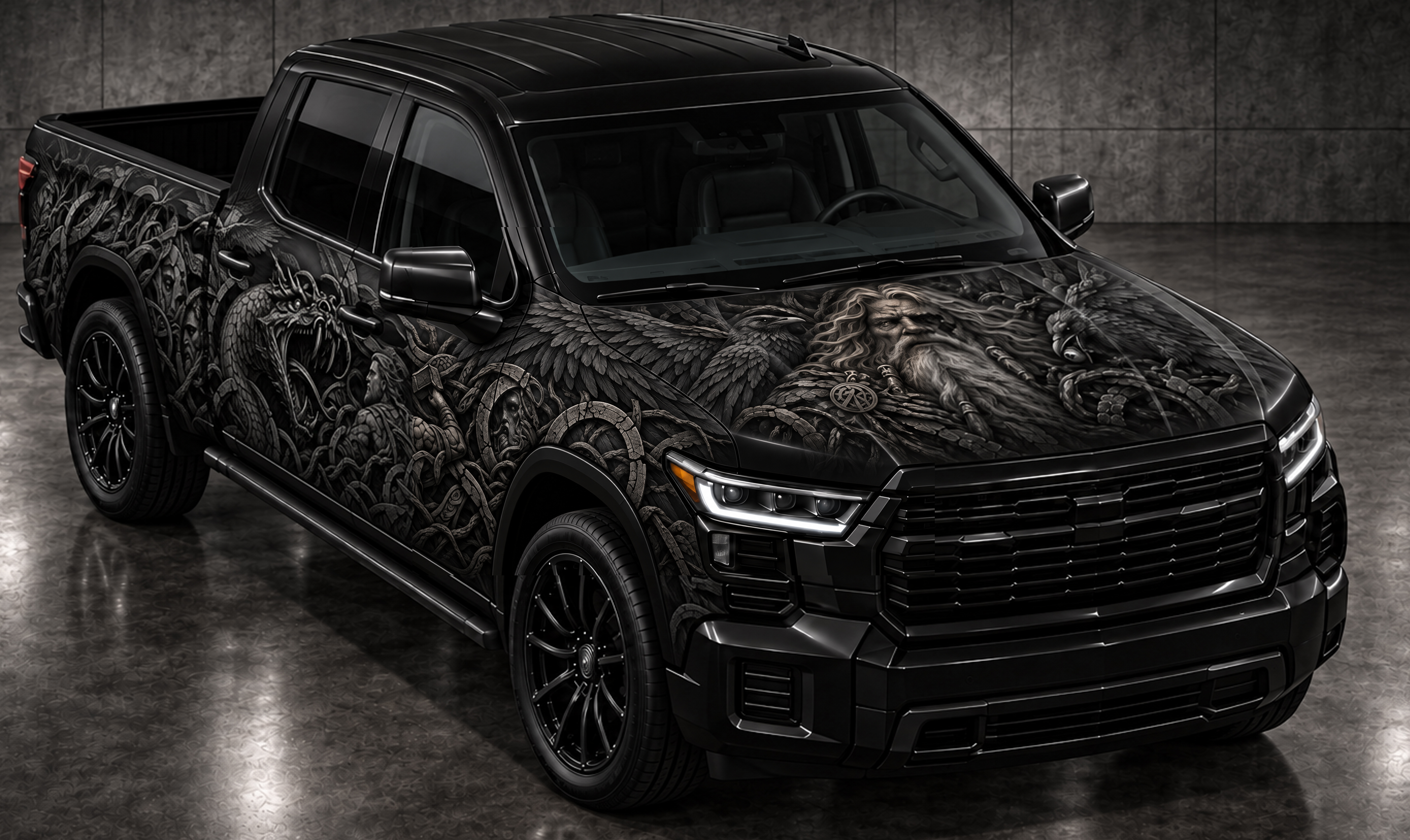
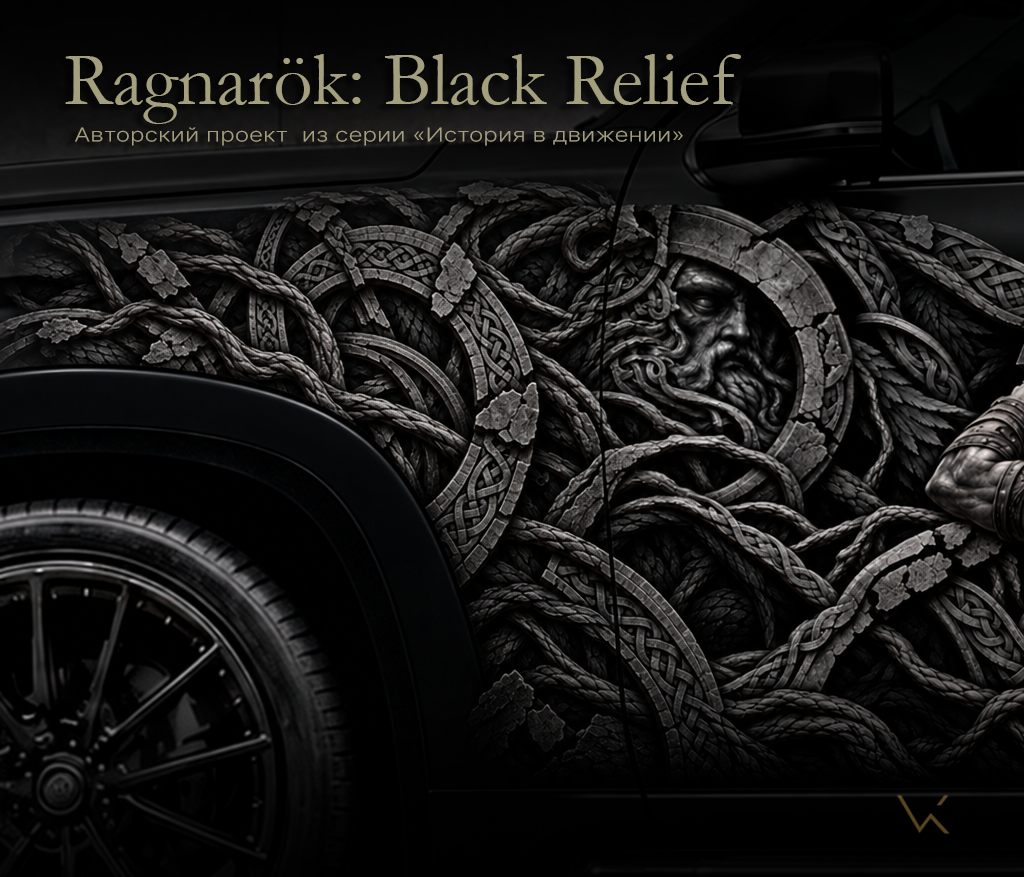
What emerges across the black surface of the bodywork is not an illustration of a Norse legend, but a fragment of one—without beginning or end. Ravens, serpents, knots, warriors’ faces, and animal silhouettes are intertwined as different eras intertwine in an old text: it is impossible to say with certainty who is pursuing, who is guarding, and who has already become part of the ornament. Each line appears to continue another; each knot is a sign that history has no straight direction.
Here, black does not serve as a background. It is like dark water or an unread manuscript: it holds the images at the threshold of visibility, allowing them to appear only as light moves across the metal. The silver forms are not applied over the bodywork—they seem to have been drawn from its depth, like a relief from stone that has lain beneath the earth for too long.
*Ragnarok: Black Relief* is not a story about the end of the world. Rather, it is a story about how every ending already contains a new road, and how every movement preserves an ancient gesture: the motion of a wing, the curve of a serpent, the track of a wheel, the run across dark ground. Thus, the automobile becomes not a carrier of an image, but a space in which the myth continues to move.
History in Motion
History rarely comes to us as a complete narrative. More often, it appears as a fragment of a frieze, part of a map, an ornament on a weapon, the name of a city on a half-erased stone. We join these fragments, assuming there is an order between them—although perhaps order is created only at the moment of reading. The series *History in Motion* emerges from this question: can historical memory be placed not inside a museum display case, but upon the surface of an object made for speed?
Here, the automobile neither becomes an illustration of the past nor serves as a neutral carrier of decorative imagery. Its body turns into a moving plane of reading, where light, shadow, and shifting viewpoints alternately reveal and conceal signs. The movement of a wheel continues the line of a campaign, the trajectory of a sea route, the curve of an ornament, the motion of a wing. What in a book would unfold sequentially exists here all at once—like a map that cannot be seen in its entirety from a single point.
*Ragnarok: Black Relief* turns to the Northern myth: to its knots, ravens, serpents, and the dark memory of metal. *Alexander the Great* is constructed differently—as a route in which the history of conquest is read through distances, shores, cities, armies, and lines of advance. In the future, the series may speak through other visual languages—for instance, through the rhythmic, calendrical, and cosmological logic of Maya ornament. Yet each new project will not be a reconstruction of a culture, but an attempt to hear how its signs continue to operate beyond their original time.
Thus, the collection is not about the past as a motionless archive, but about a past that changes its meaning with every new glance. The car moves away, the image breaks apart in reflections, ornament becomes a route, and the route becomes a text. And the viewer understands: history does not remain behind us. It moves alongside us—sometimes faster than we do.
Reservation and project implementation terms are discussed personally.