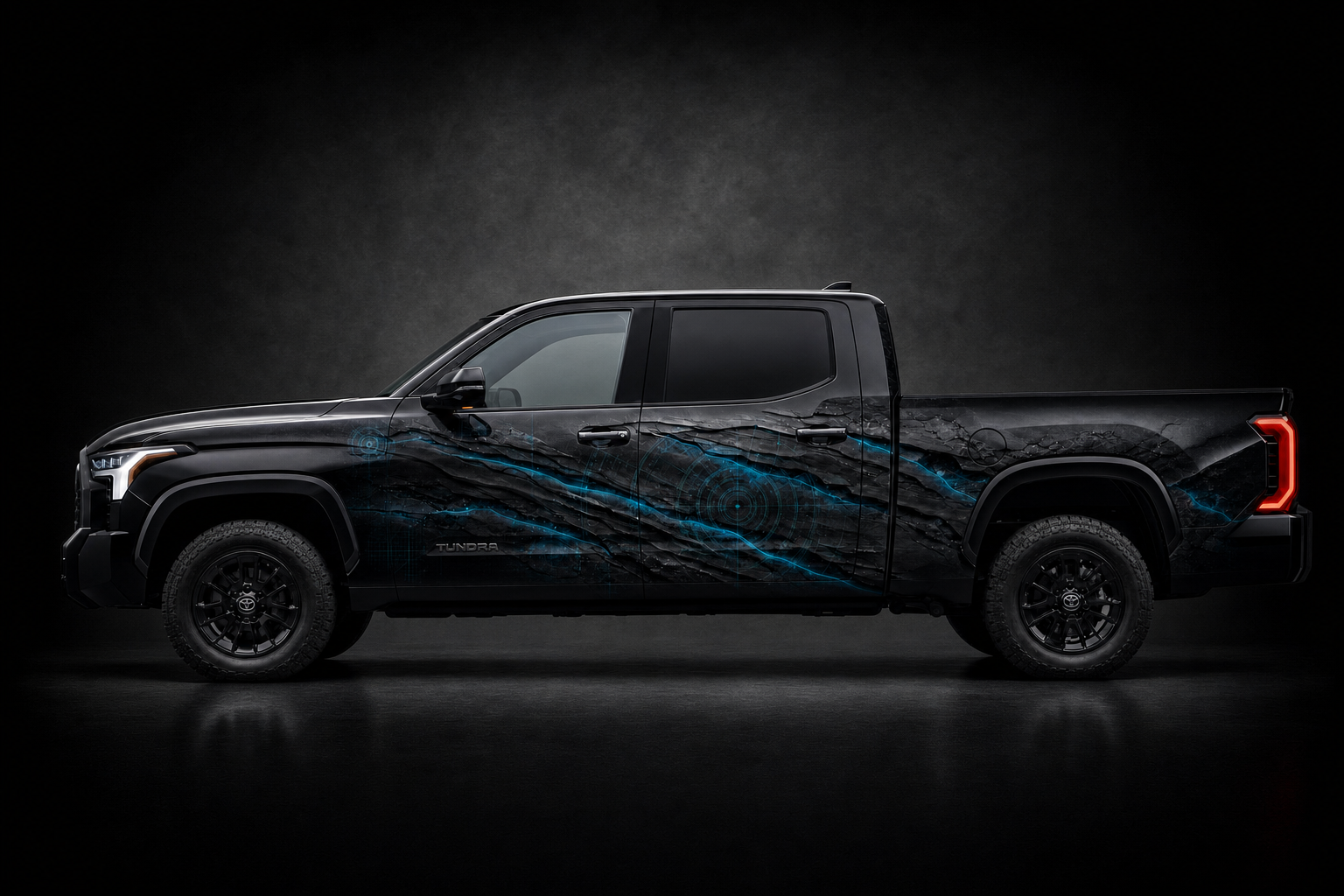
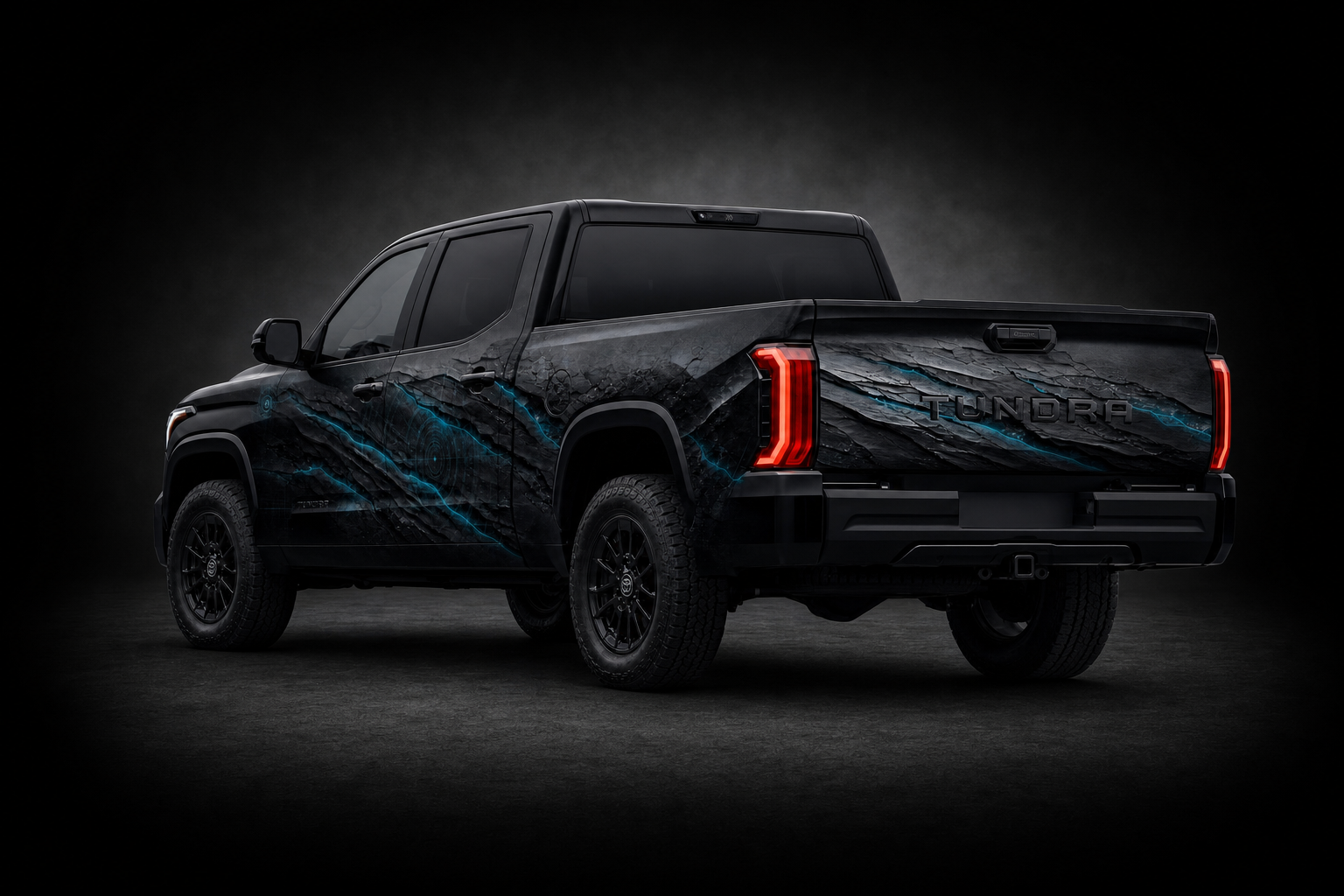
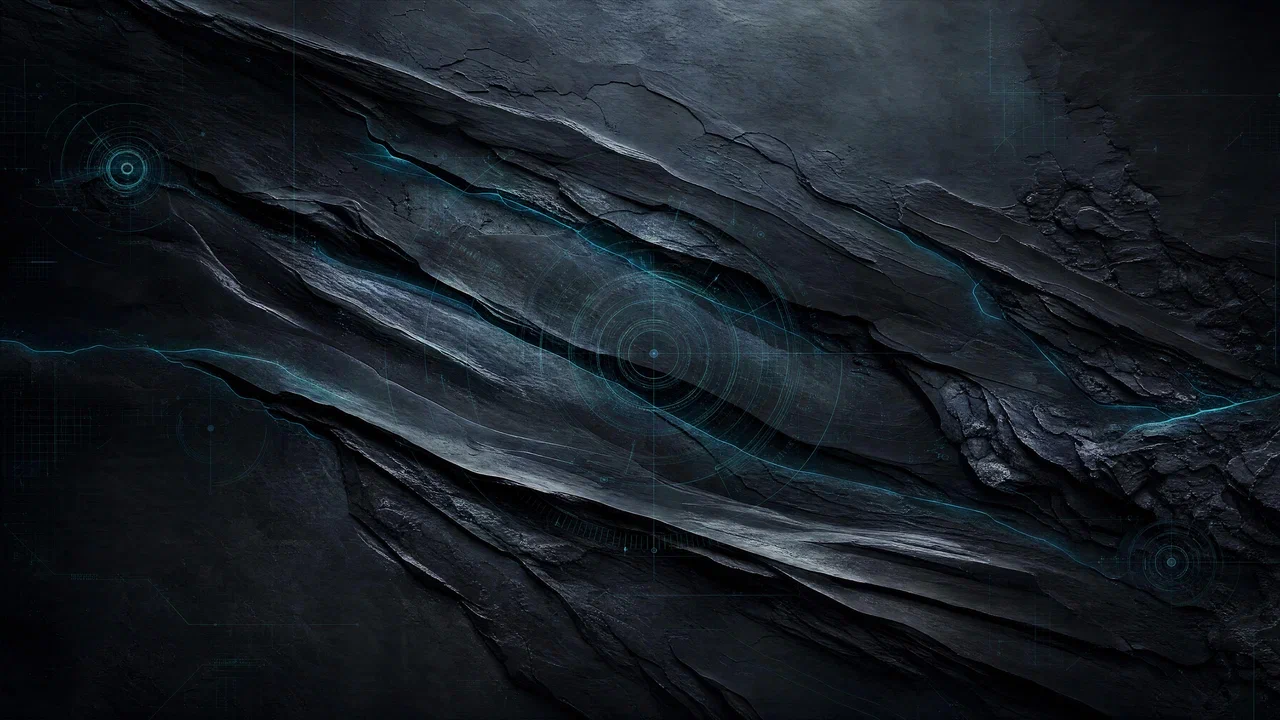
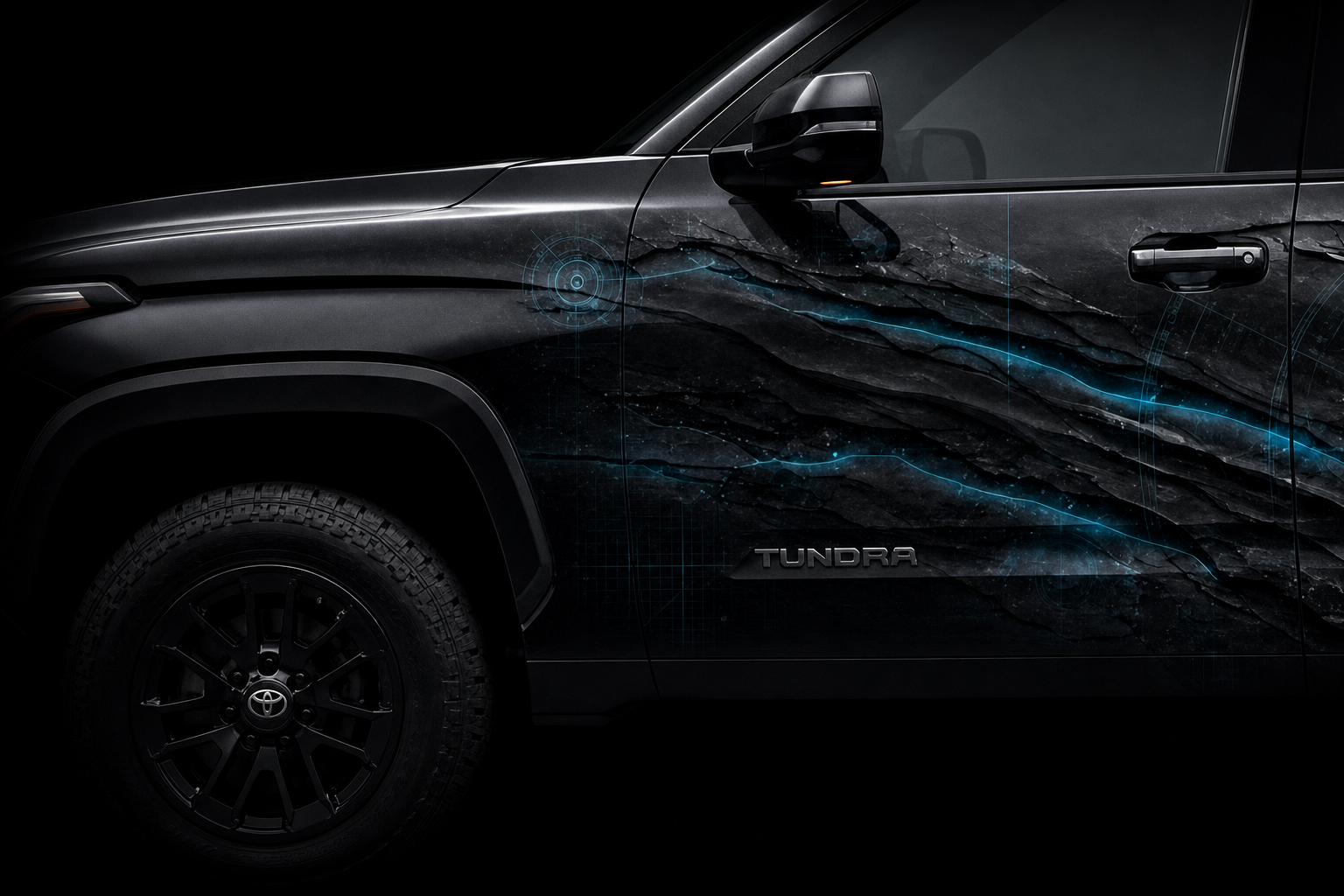
A fractured geological field permeated by a restrained internal system.
About the project
The most expressive solution for **TECTONIC SIGNAL** is to extend the airbrush composition across both sides of the vehicle and continue it onto the tailgate. This scale allows the body to be perceived as one continuous tectonic surface rather than a collection of separate decorative fragments placed on individual panels.
The composition begins at the front fenders in a more restrained, dispersed state: the first fine fractures, cold cyan signals, and barely visible technical markings appear here. It then moves through the doors, gradually gaining density, depth, and scale. The central section of the sides becomes the area of the most complex interaction between mineral layers, dark fissures, and secondary graphic structures.
Toward the rear, the composition reaches its maximum intensity. Across the rear bedsides and tailgate, the tectonic layers gather into a larger, more cohesive relief. The cyan veins remain sparse and embedded within the depth of the fissures, never becoming an independent lighting effect. The continuation of the artwork onto the tailgate is particularly important: it connects both sides through the rear of the vehicle and resolves the movement of the composition as one strong, unified gesture.
Through this logic, TECTONIC SIGNAL functions not as an illustration applied to a vehicle, but as a new material architecture for the body—dark, composed, monumental, and legible from every angle.
Project history
TECTONIC SIGNAL** is an original project for the Toyota Tundra, developed as an extended composition across both sides of the vehicle and the tailgate. The artwork moves through the front fenders, doors, rear bedsides, and tailgate, gradually increasing in density toward the rear of the vehicle. Its visual language is built from layered graphite-and-stone structures, deep fissures, sparse cold cyan veins, and restrained technical graphics.
The final cost is determined after the technical layout has been developed for the specific vehicle, its condition has been inspected, and the density of the artwork has been approved. The figures below are indicative estimates based on the scope of handwork and the selected production method.
#### Multi-layer airbrush painting with an illusion of depth
**From RUB 500,000**
The primary execution option is a deep painterly airbrush finish beneath clear coat, without physical relief. The effect of tectonic layers, fractures, and depth is created through sophisticated work with transparency, shadow, graphite tonal relationships, and multiple layers of hand-painted detail.
This option includes preparation and partial disassembly of the required components, development and transfer of the composition onto the bodywork, airbrushing across both sides and the tailgate, clear coating, sanding, polishing, and final reassembly. It preserves the clean geometry of the vehicle, offers strong repairability, and is suitable for regular use.
#### Collector’s version with local micro-relief
**From RUB 800,000**
In this version, selected tectonic fissures receive a real yet highly subtle physical texture. The micro-relief is formed only within key areas of the composition—for example, on the rear bedsides and tailgate—and is then integrated into the paintwork and multi-layer clear-coat system.
This approach requires a separate relief map, material tests for adhesion and shrinkage, hand-forming of the surface, careful refinement of transitions, additional priming, painting, and a more complex finishing process. The relief remains minimal and controlled: it strengthens the sense of material depth without turning the bodywork into an applied decorative structure.
If required, the following are quoted separately: the author’s technical layout, a change of the vehicle’s base colour, extended disassembly of components, and protective paint protection film after completion.
TECTONIC SIGNAL is conceived not as decorative graphics placed on a vehicle, but as a new material architecture for its body. For this reason, the optimal primary solution is multi-layer airbrush painting with a convincing illusion of depth, while physical micro-relief is offered as a limited collector’s option.
Модель
SURFACE CODE
A collection of automotive texture concepts in which the artwork functions not as a separate image, but as the character of the surface itself.
Each concept is built around its own material language: layered stone and technical linework, charred wood with an inner glow, gilded crocodile-skin texture, a directional feather rhythm, topographic layers, and relief-like structures. The central idea of the series is to turn the vehicle body into a carrier of complex, tactilely legible surfaces.
The designs can be realized in two ways.
**The painted version** creates volume through airbrushing, light, shadow, and tonal transitions.
**The relief version** involves physical work with the surface: the texture becomes tangible, and the design changes with the angle of light and the movement of the vehicle.
Reservation and project implementation terms are discussed personally.