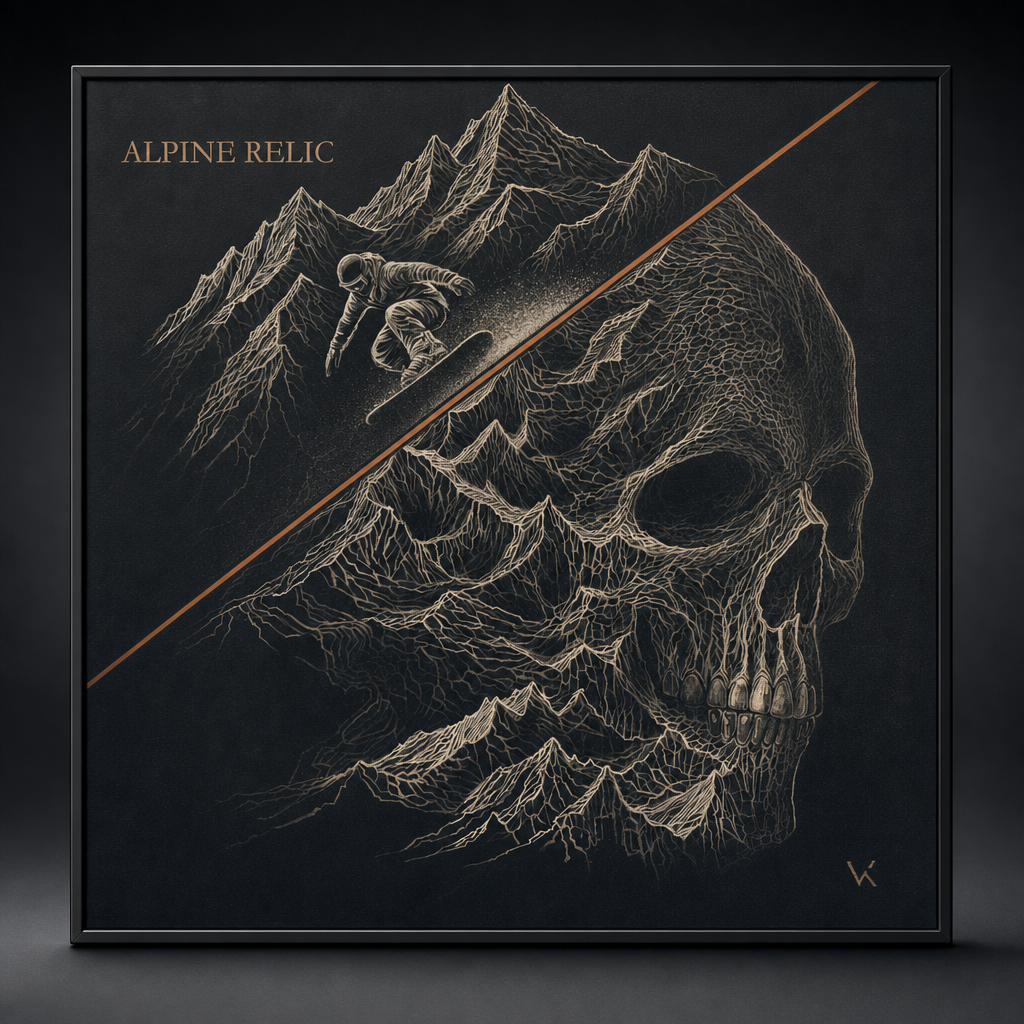
**ALPINE RELIC** is an original airbrush project conceived as an engraved surface system.
At its core is an interest in the visual language of historic printmaking: the discipline of line, the density of hatching, and the drama of light and relief. The project draws not on literal quotation, but on the artistic thinking of Albrecht Dürer and Francisco Goya — their ability to bring tension, materiality, and inner movement into a restrained palette.
The artwork is executed in a mixed technique. The brush establishes drawing, hatching, texture, and engraved depth; the airbrush creates tonal transitions, atmosphere, smoky distance, and connects the image to the volume of the vehicle. As a result, the work does not read as an illustration applied onto the bodywork: it unfolds across the vehicle’s form, following its panels, edges, and direction of movement.
Mountain relief, the trace of speed, and concealed symbolic imagery are brought together as one continuous system. Here, the vehicle is not a background for the artwork, but the carrier of a graphic gesture — dark, deliberate, and tactile.
Thoughts
THE IMAGE OF THE SKULL
The skull is one of the most concentrated images in the history of art. It embodies not only a reminder of mortality, but also a density of meaning rarely found in visual symbols: memory, limit, dignity of form, fearlessness, and inner transformation.
For centuries, the image of the skull has held a distinctive place in visual culture precisely because it has never been confined to a single meaning. Its presence in art has never been merely about outward effect, but about ultimate clarity. It is a sign that strips away the unnecessary and returns the gaze to what is essential.
In the European tradition, it became a reminder of the fragility of earthly things — beauty, power, wealth, time. In other cultural and ritual contexts, it carried a different resonance: not a denial of life, but an acknowledgment of its depth, its limits, and its connection to memory, transition, and inner strength. This is why the image has endured across eras, styles, and aesthetic systems without losing its expressive power.
The skull is a form in which all that is accidental disappears. What remains is structure, truth, and that which has no need of embellishment. This is where its artistic force resides. It does not illustrate darkness, nor does it seek decorative severity. On the contrary, in a strong visual work, this image reveals itself as a symbol of inner composure, lived experience, freedom from the superficial, and the ability to pass through transformation without losing one’s core.
In contemporary art, the skull continues to resonate because it speaks a language that does not age. It is the language of limit, memory, and form — a visual language in which beauty is inseparable from depth, and strength from inner truth.
For me, the skull is not a sign of gloom, but an image of concentrated meaning. It holds within itself memory, strength, limit, and transformation, turning visual form into a statement that cannot be read superficially.
art object
1
Reservation and acquisition terms are discussed personally.